

User Backlash Grows Against Google's AI Integration in Search Engines
User Backlash Grows Against Google's AI Integration in Search Engines
Why are users leaving Google search for DuckDuckGo?
There is a clear, human-sized reaction happening in the search world right now. After Google announced a big push toward AI-driven search at its 2026 I/O developer conference, a portion of users started to vote with their feet. They are not just grumbling on forums; they are installing different apps and trying different browsers. That matters because search is the plumbing of the internet — small changes ripple widely.
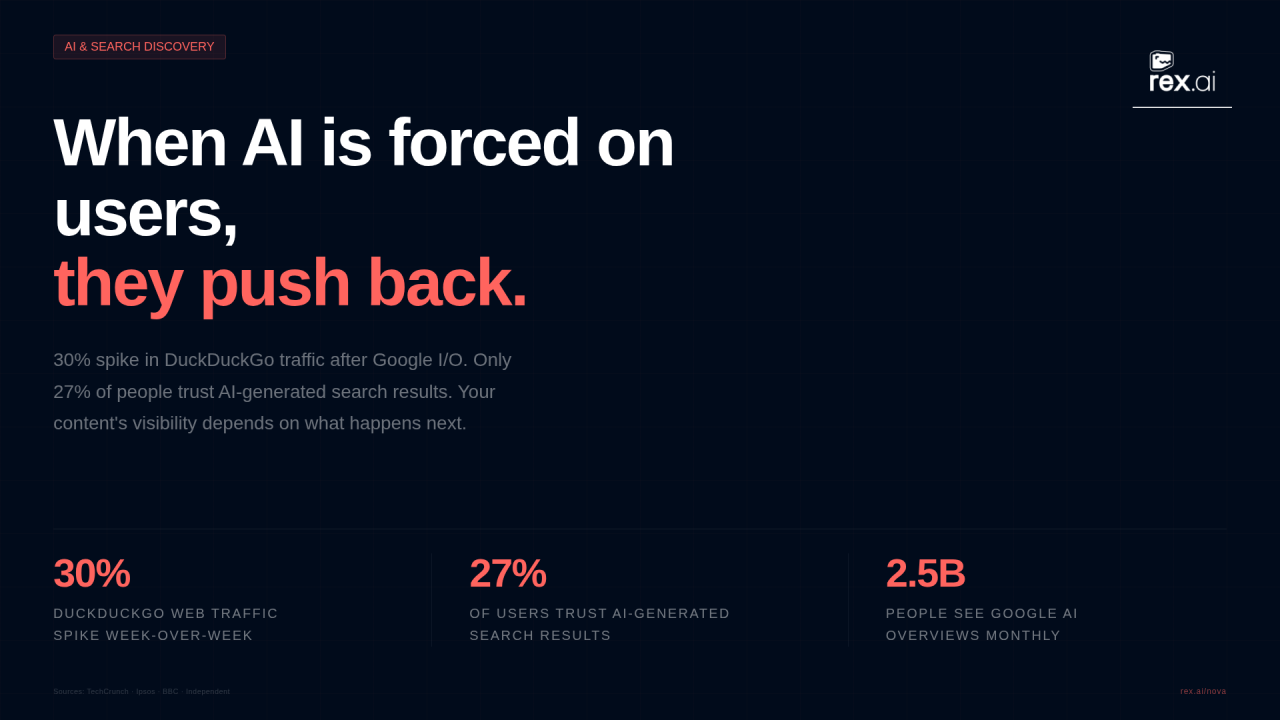
The pattern is simple to describe and not hard to empathize with. People noticed AI-generated answers appearing in places they used to trust for straightforward links and source material. Some users felt those AI summaries were savaging clarity and diminishing the quality of results. As the coverage collected in the payload shows, that reaction translated into tangible behaviour. For example, TechCrunch reported a "nearly 30% increase in web visits to DuckDuckGo's no-AI search page" week-over-week following Google’s announcement, alongside substantial rises in app installs.
That kind of movement is not mass-market upheaval yet. Google still has more than 90% market share according to the reports. But even pockets of persistent dissatisfaction can create new product opportunities and, more importantly, reframe the discussion about what users expect from search: accuracy, control, and transparency.
There is another human factor here: trust. If a tool starts behaving in ways people do not understand or cannot control, they will look for alternatives that feel more predictable. Gabriel Weinberg, DuckDuckGo’s CEO, told the Independent that "Google is force-feeding AI with no way to opt out." That quote captures the sense of frustration driving some of the switch.
How big is the DuckDuckGo surge in downloads and traffic?
The data we have points to a meaningful, if uneven, surge for DuckDuckGo. Different outlets reported variations, but the direction is unanimous: interest spiked after Google’s AI-first announcements. For example, TechCrunch recorded "a 30% increase in web visits to its no-AI search page week-over-week" and noted that "U.S. app installs for DuckDuckGo rose by 18.1% week-over-week" with iOS installs jumping 69.9% in a week.
Other outlets reported even larger swings. Wide Open Country relayed Pubity data suggesting a "300% increase in traffic" for DuckDuckGo since Google ramped up AI. And Gizmodo documented surges in app installs and traffic to the AI-free page.
Numbers vary by source and timeframe, and that is expected. The important point is that multiple independent reports agree there was a significant lift in interest. That lift is not necessarily a permanent defection, but it is a sign that some users are actively searching for ways to avoid or reduce AI in their search experience.
Is Google search quality getting worse with AI integration?
That is the central accusation many critics are making. Headlines and opinion pieces have used strong language, calling parts of the change "disastrous" or worse. ExtremeTech questioned whether Google’s pivot toward an AI chat interface could be "potentially disastrous for both the company and the broader internet ecosystem." The claim is that prioritizing AI over traditional search links can undercut the very content ecosystem Google monetizes.
People point to incorrect or bizarre AI answers as concrete failures. Gizmodo collected examples of odd AI outputs, including false country facts and strange recipe suggestions. Other coverage suggested that the AI summaries sometimes obscure the provenance of the underlying information, leaving users unsure where claims came from.
It is important to be cautious here. The coverage shows a lot of negative sentiment and vivid examples, but it is not the whole story. Some users may appreciate concise AI summaries. The payload itself notes this is a mixed picture: "Research indicates a mixed sentiment towards AI-assisted search." Still, the volume of critical reporting is notable and matters because it shapes public perception and user behaviour.
What are the privacy and manipulation risks people worry about with AI search?
Two connected fears bubble up in the reporting: first, that AI models can be manipulated to yield false or misleading statements; second, that users lose the ability to see original sources and evaluate claims for themselves.
The BBC ran a pointed experiment showing how an author could trick AI systems into making false claims about themselves, in one case persuading an AI to state "he is a world-champion hot-dog eater." The article underscored that vulnerabilities in AI chatbots can be used to spread misinformation. As the BBC summarised, "Lily Ray told BBC: 'You should assume that you're being manipulated until they have better systems in place.'"
Those problems are not theoretical. The BBC also reported that "2.5 billion people see Google's AI overviews each month," which amplifies the potential impact when something goes wrong. Harpreet Chatha told the BBC that the concern includes "the economic impact" of degraded or manipulated search outputs and that policy updates are likely to push bad actors toward new tactics.
Trust and provenance are central. When AI summarises multiple sources into a single output without clear attribution, people worry they cannot judge accuracy. That is why transparency and traceability matter so much in this debate.
What does this backlash mean for publishers and SEO strategies?
For publishers and marketing teams, the immediate worry has two parts: fewer visits and less clarity about credit. Traditional search results send traffic to websites. If AI answers replace link lists with a summary, publishers may see traffic decline. Researchers and outlets have been flagging this risk since AI-first formats began to spread.
Business models built on referral traffic could be disrupted. The payload contains historical references reminding us that when AI search formats first emerged, analysts warned of advertising and publisher impacts. The Business Insider piece from 2023 noted similar concerns about digital advertising and publisher traffic when chat-style AI search interfaces started gaining attention.
Practically, marketers should not panic, but they should adapt. Cleaner attribution, structured content, and concise answers that feed AI summaries will be increasingly valuable. In other words, if search engines are condensing information, make sure your content is the clean, verifiable signal they are likely to cite.
This is where News Media Intelligence matters. Tools that group coverage, tag sources, and surface the primary facts across outlets can help brands ensure their perspective and evidence are discoverable and attributable. If AI systems prefer concise, reliable fragments of reporting, then structured, well-attributed content wins.
How should marketing leaders respond to Google’s AI changes right now?
Calm, iterative action is the sensible path. There are three practical moves I would suggest for marketing and communications leaders who are watching this unfold.
First, preserve clear attribution everywhere your content appears. If AI systems increasingly synthesise information, the systems that provide explicit citations will be more trustworthy and more likely to be surfaced. That is a defensive play that also aligns with ethics.
Second, invest in diversified discovery channels. The sudden interest in alternatives like DuckDuckGo and Vivaldi, as reported by Wide Open Country, means that single-channel dependency is riskier than before. Test content delivery on alternative search and browser ecosystems, and maintain direct channels to your audiences such as email, social, and owned apps.
Third, focus on structured signals. SEO remains vital, but think beyond keywords. Provide clear, factual snippets that answer likely user questions and include transparent sourcing. Those are the slices of content that AI answers will be built from.
These moves are not about gaming a system. They are about ensuring that your audience can see and verify the sources behind any synthesized output. And that ties back to an ethical responsibility as well as a commercial one.
How can News Media Intelligence help brands adapt to the changing search landscape?
If you are a CMO, head of marketing, or brand director, you need tools that reduce friction between facts in the world and the narratives your team publishes. That is where News Media Intelligence matters. The payload’s framing and the product positioning from rex.ai make this plain: grouping coverage into multi-perspective story clusters, providing attribution, and generating SEO-optimised long-form content are practical levers.
Rexnova, for example, is presented as "an intelligence-driven content generation engine that groups news articles discussing the same story, capturing multiple perspectives on a single event." By design, it produces original long-form publications "automatically optimized for SEO, GEO, and Voice Search, and trained to produce language indistinguishable from human writing." That matters in two ways.
First, it speeds up content production dramatically. The FAQs claim rexnova cuts "80-95% of the time typically spent creating SEO blog content." Time saved translates into more rapid reaction to breaking stories and more consistent signals for search engines to reference.
Second, it prioritises ethics and attribution. According to the FAQs, rex.ai "never copies or republishes full articles" and ultimately aims to "drive readers toward original journalism, not divert from it." That commitment matters because when aggregated AI answers lose trust, brands that prioritize transparency will have a reputational advantage.
If you want to understand more about the company's stance on ethical scraping and attribution, see rex.ai's note on "morally scraping" at https://rex.ai/scraping-info. If you care about legal and privacy compliance, rex.ai points to its adherence to GDPR and CCPA at https://rex.ai/privacy-policy. And for an overview of the company and its ethos, there is the main site at https://rex.ai.
Can ethical AI like rexnova help brands keep control of their narrative?
Short answer: yes, it can help, provided the controls are chosen carefully. The key difference between ethical News Media Intelligence and generic AI content generators is the insistence on provenance and on surfacing multiple perspectives rather than asserting a single, decontextualised version of events.
Rex.ai's approach, according to the payload, is about pairing "ethical AI with responsible data practices." The platform detects story connections, groups coverage by perspective, and "extracts key facts and quotes, always referencing the original source material." That process is not a silver bullet, but it is the right shape of a solution for organizations that want to be part of the public conversation without eroding trust.
Brands do not need to decide between being present in public discourse and being ethical. They can do both. The practical steps include ensuring content is transparent about sourcing, avoiding overclaiming, and using machines to amplify human editorial judgment rather than to replace it. The payload emphasises that rex.ai is "built on the belief that AI should enhance human journalism, not replace it."
So if your priority is protecting brand reputation while also maintaining the discoverability and relevance of your content, ethically structured News Media Intelligence systems give you a pathway: faster, sourced, and balanced content that aligns with evolving discovery systems.
What are the broader implications for the future of search and the open web?
We should avoid hyperbole here but stay candid about the stakes. The coverage presents a crossroads. On one path, dominant platforms pursue AI-first interfaces that aggregate and summarise content for users. On the other path, alternative engines emphasise control, privacy, and optionality.
The reports combined in the payload suggest that user choice will matter. The Independent quoted Weinberg as saying that users should be empowered to choose how much AI they want in search. At the same time, the BBC’s investigation into manipulation risks makes clear that choice without better safeguards is not enough. We need both user control and stronger provenance.
For the open web, the commercial model is in play. If AI answers reduce clickthroughs to publishers, the economics of online journalism will change. That will pressure publishers to adapt their content formats, to insist on clearer attribution, and to explore alternative revenue channels. For technologists, the work is to build AI that is robust to manipulation and transparent about sources. For communicators, the work is to create content that is discoverable and clearly attributable.
None of this is inevitable. The choices of engineers, product managers, and policy makers will shape whether AI in search becomes a helpful summariser that points to sources or a black box that eats the links that sustain the web. The present backlash is a reminder that users care about those choices.
Three modest steps every communications leader can take this week
If you are responsible for content and reputation, here are three practical, low-friction steps to consider right now.
- Audit your top-performing content and make source signals explicit. Add clear, machine-readable citations and concise summaries that make your content easy to cite in an AI synthesis.
- Diversify discovery. Don’t rely solely on one search provider. Test alternative engines and optimize for them where it makes sense. Consider how your content looks in a chat-style summary as well as on a link list.
- Invest in a transparent News Media Intelligence workflow. Tools that group perspectives and provide attributions help you produce balanced narratives quickly and defensibly. If you want to explore an approach that emphasises ethical AI and attribution, see https://rex.ai and consider contacting the team for a demo at nova@rex.ai.
Questions people ask
Q: Is the backlash against Google large enough to change market share?
A: The reporting shows meaningful movement among certain user groups and spikes in downloads and traffic for alternatives, but Google still retains more than 90% market share in many metrics. The situation is dynamic: small shifts can grow over time, especially if users’ trust continues to erode. The payload cautions that we are at a crossroads where user agency may shape the future of search.
Q: Are DuckDuckGo’s gains permanent?
A: We cannot claim permanence from the data provided. Multiple outlets reported surges in traffic and installs for DuckDuckGo after Google’s announcements. For example, TechCrunch and Wide Open Country described strong short-term increases. Whether those gains last will depend on retention, product experience, and whether Google changes course.
Q: How reliable are AI-generated search answers?
A: The coverage suggests a mixed and cautious picture. Surveys cited in earlier reporting indicated skepticism: "An Ipsos survey found that only about 27% of individuals trust search results generated by AI," as referenced in the summary of historical reporting. And investigative pieces like the one from BBC showed how chatbots can be manipulated to produce false claims. So, reliability varies and provenance matters.
Q: What should my content team change in response?
A: Emphasize attribution and structured content. Make your claims traceable back to reputable sources, build concise summaries that an AI can cite accurately, and diversify discovery channels. These are practical adjustments that protect both SEO and reputation.
Q: Can technology like rexnova help my team publish faster without compromising ethics?
A: According to the product description in the payload, rexnova is designed to accelerate content creation while preserving attribution and transparency. The FAQs claim time savings ("80-95% of the time typically spent creating SEO blog content") and emphasise ethical safeguards like not republishing full articles and attributing sources. If you want to learn more, visit https://rex.ai or read their note on ethical scraping at https://rex.ai/scraping-info, or contact the team at nova@rex.ai.
Q: Where can I read the original reporting cited here?
A: The analysis above draws directly on the reporting linked in the payload, including pieces from TechCrunch, ExtremeTech, Independent, Gizmodo, Wide Open Country, and BBC. Each of those pieces contains the specific data points and quotations referenced above.
Final note: This moment is less about a single company misstep and more about a larger question: how do we keep the internet useful, verifiable, and fair as AI becomes part of the user experience? For leaders in marketing and communications, the practical answer is to make your content easy to verify, present it in machine-friendly formats, and diversify how you reach people. If you want a partner that prioritizes ethics and attribution in news-driven content creation, you can explore options at https://rex.ai or email nova@rex.ai to talk about rexnova.
Resources
DuckDuckGo is experiencing a surge in traffic as it emphasizes its no-AI search engine alternative amidst growing public resistance to AI integration in search engines. The company has launched new browser extensions for Chrome and Firefox, enabling users to set its no-AI search experience as the default. DuckDuckGo’s no-AI page claimed nearly 30% increases in web visits and significant growth in app installs following Google’s recent AI-centric changes to its search engine, which prioritize AI-generated responses over traditional search results. Despite its focus on providing an AI-free experience, DuckDuckGo continues to offer AI tools and services, signaling a nuanced stance towards AI technology.
https://extremetech.com/internet/how-to-search-in-the-era-of-ai
The article discusses Google's recent shift towards an AI-first model for its search engine, critiquing this decision as potentially disastrous for both the company and the broader internet ecosystem. It suggests that this move is motivated by a fear of being outperformed by AI-powered competitors, even at the cost of alienating users and degrading service quality. The article provides several alternatives for users who wish to avoid AI-driven search results, including suggestions for browser plugins and alternative search engines like DuckDuckGo and Startpage, highlighting a growing user demand for non-AI search options amidst rapid AI integration.
https://independent.co.uk/tech/duckduckgo-ai-google-search-b2986989.html
The article discusses the significant increase in users for DuckDuckGo, a privacy-focused search engine, following Google's announcement of major AI-related updates during its annual I/O developer conference. After Google's introduction of AI-driven search capabilities, DuckDuckGo experienced nearly a one-third rise in app installations, alongside a tripling of interest in its 'No AI' search functionality. The article presents DuckDuckGo as a challenger to Google's overwhelming market share, noting that Google's market share exceeds 90% compared to DuckDuckGo's 0.7%. Additionally, it highlights DuckDuckGo's marketing strategies that position the platform as a user-centric alternative to Google's aggressive AI integration, which has faced criticism for its potential impact on the open web and the perceived decline in search quality. DuckDuckGo's CEO, Gabriel Weinberg, articulated a desire to empower users in deciding the extent to which they engage with AI in search results.
The article discusses the increasing dissatisfaction with Google due to its integration of AI in search results, which has led to a notable exodus of users seeking alternatives like DuckDuckGo. The author highlights peculiar AI-generated answers from Google and the declining quality of search results, which contrasts with DuckDuckGo’s anti-AI marketing strategy. DuckDuckGo has seen significant growth in app installs and traffic to its AI-free search engine, appealing to users who prefer a more traditional, AI-free internet experience. The underlying commentary reflects a broader skepticism towards AI and its implications for privacy and data management.
https://wideopencountry.com/internet-users-begin-turning-backs-on-google-in-protest
The article discusses the backlash against Google as users increasingly turn to alternative search engines like DuckDuckGo and browsers such as Vivaldi due to Google's growing emphasis on AI in navigating search results. As Google's AI-integrated search diminishes organic traffic to websites, many users feel alienated by the changes. According to data from Pubity, DuckDuckGo has experienced a remarkable 300% increase in its traffic since these changes were initiated by Google. Additionally, the article highlights the increasing popularity of the Vivaldi browser, particularly among users shifting away from Google Chrome, emphasizing the sentiment against the tech giant's direction. This trend suggests a potential for substantial market share loss for Google if users continue to embrace these alternatives.
https://bbc.com/future/article/20260519-google-tackles-attempts-to-hack-its-ai-results
A BBC investigation reveals how AI chatbots, including those from Google, are vulnerable to manipulation, allowing individuals to spread misinformation easily. The article discusses a personal experiment where the author convinced AI systems to falsely state he is a world-champion hot-dog eater, exemplifying the risks of AI-generated information. Experts warn that this type of manipulation can lead to serious consequences, influencing public health and financial decisions. Google has updated its spam policies in response, but challenges remain as bad actors continue to exploit these systems. The piece highlights a broader concern regarding trust in AI, as well as the economic and legal implications of biased or inaccurate information disseminated by these technologies.
https://businessinsider.com/chatgpt-and-generative-ai-search-format-ripe-for-revolution-2023-5
As Microsoft and Google engage in a fierce battle to integrate AI into their search engines, significant disruption looms over the digital advertising landscape. The article highlights OpenAI's ChatGPT, which achieved rapid popularity, prompting both tech giants to adopt AI-enhanced search functionalities. Despite initial interest from users in AI-assisted search, concerns linger about its implications for traffic to publishers and advertising models. Research indicates that while many adults express interest in AI-driven searches, a considerable percentage remains skeptical about the reliability of these AI-generated results, especially given previous failures. The monetization of AI-assisted search remains a complex issue, bringing uncertainty to the future of digital advertising.
Related articles
Google Just Got Told It Can't Have Your Content for Free.
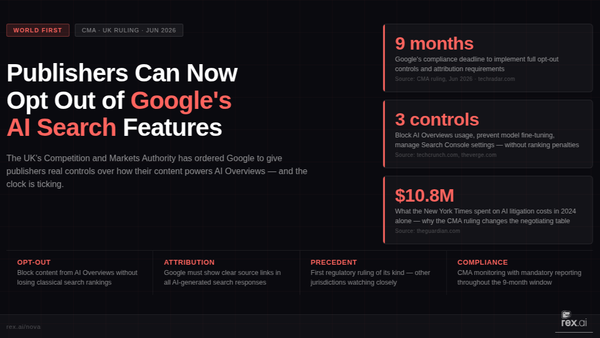
Last week the UK’s Competition and Markets Authority (CMA) issued a ruling that, in plain terms, gives online publishers a new degree of control over how their content is used.
Google Launches Search Profiles for Creators and Publishers
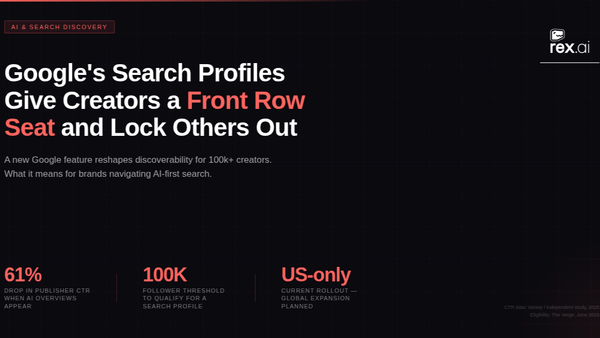
Google has introduced a new feature called Search profiles that gives creators and publishers a dedicated, shareable page inside Google Search.